 +49 4122 922 - 0
  info@helling.de
  Mo. - Do. : 8:00 - 16:30 Fr. : 8:00 - 13:00



Calibration and Certification
DAkkS and Factory Calibrations
UV Irradiance Meters
Illuminance Meters
Measurement and Certification of UV LED Lamps
Certificate of Conformity according to DIN EN ISO 9934, DIN EN ISO 3059 and DGZfP EM 06
Measurement Report – Manufacturer's Specifications acc. to DGZfP-EM 06
Certification of UV LED Lamps for the Aviation Industry
Certificate according to ASTM E-3022
Certificate according to AITM 6-1001
Certificate according to Rolls Royce RRES 90061
Penetrant Testing
Magnetic Particle Testing
Radiographic Testing
Further Measurements
Optical Measurement Laboratory – Precision through Calibration
DAkkS and factory calibrations are carried out in the newly equipped optical measurement laboratory. The laboratory is subject to test equipment monitoring in accordance with DIN EN ISO 9001:2015 and is also accredited by DAkkS in accordance with DIN EN ISO/IEC 17025:2018 for illuminance and irradiance UV-A 365 nm under the registration number D-K-23091-01-00.
The calibration certificates document the metrological traceability to national standards for the representation of units in accordance with the International System of Units (SI).
DAkkS Calibrations
- Smallest measuring uncertainties
- Illuminance calibration range 5 lx – 2000 lx with a relative extended measurement uncertainty of up to 3.3 %
- Irradiance UV-A 365 nm calibration range 100 µW/cm² – 10,000 µW/cm² with a relative extended measurement uncertainty of up to 7.5 %
- Worldwide acceptance
- Traceability to national standards
Factory Calibrations*
- Small measuring uncertainties
- Illuminance calibration range 5 lx – 2000 lx with a relative extended measurement uncertainty of up to 5 %
- Irradiance UV-A 365 nm calibration range 100 µW/cm² – 10,000 µW/cm² with a relative extended measurement uncertainty of up to 9 %
- Acceptance depends on the auditor
- Traceability to national standards
*Factory calibration certificates are not covered by the EA MLA
UV Irradiance Meters
The calibration (both initial and re-calibration) of a UV irradiance meter is performed using a reference measuring device by directly comparing (substitution method) the measured values of the calibration object with those of the reference measuring device. The emission spectrum of the UV source is checked during the measurements with a spectroradiometer.
The Helling UV LED emitter system H365 with a nominal peak wavelength λ = 365 nm and a nominal half-width Δλ = 8.5 nm is used to calibrate the calibration object. The specified nominal values of the UV irradiance were set by changing the distance between the reference standard and the radiation source.
The calibration procedure used meets the requirements of (Document Appendix D-K-23091-01-01, Radiometry, as of January 29, 2026)
- ASTM E2297-23
- DIN EN ISO 3059:2013 Section 8
- CIE 220:2016
- ASTM E824-10(2018)
Illuminance Meters
The calibration (both initial and re-calibration) of an illuminance meter is performed using a reference illuminance meter by directly comparing (substitution method) the measured values of the calibration object with those of the reference device. The supply current of the A source is adjusted and stabilized using a power supply. Light sources of standard illuminant type A with a nominal distribution temperature of 2856 K are used to calibrate the calibration object.
The specified nominal values for illuminance were set by changing the distance between the reference standard and the light source.
The calibration method used meets the requirements of (Document Appendix D-K-23091-01-01, Photometry, as of January 29, 2026)
- DIN EN ISO 3059:2013 Section 8
- ASTM E2297-23
- BS 667:2005 Annex B2.2
Measurement and Certification of UV LED Lamps
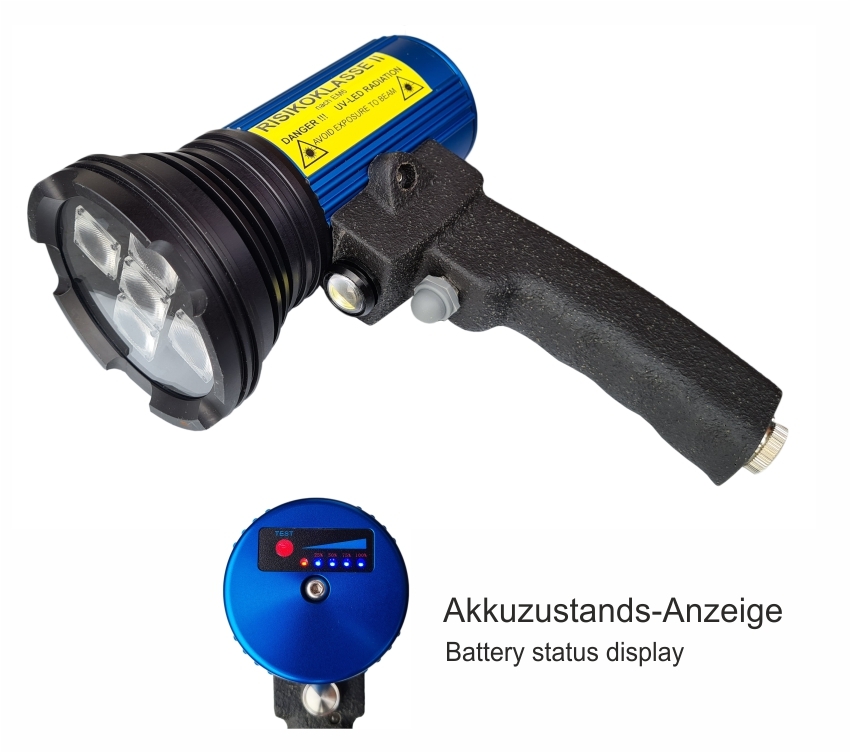
UV Inspector 715 with battery level indicator
Certificate of Conformity according to DIN EN ISO 9934, DIN EN ISO 3059 and DGZfP EM 06
Absolute spectral measurements of UV lamps with traceable calibrated detectors in an air-conditioned optical measurement laboratory.
- DIN EN ISO 9934 – Non-destructive testing – Magnetic particle testing
- DIN EN ISO 3059 – Non-destructive testing – Penetrant testing and magnetic particle testing – Viewing conditions
- DGZfP-EM 06 – Inspection areas for fluorescent testing with magnetic particle and penetrant testing – Equipment and protection measures during operation with UV radiation
The following parameters are checked:
- Wavelength
- Full width at half maximum (FWHM)
- UV lamp risk class
- Maximum value of Eeff
- Maximum value of Eλ
- Nominal value of irradiance Ee
- Irradiance homogeneity
- Area irradiated with 50 % Ee
- Irradiance after 15 min. operating time
- Irradiance after 200 h continuous operating time (typical value)
- UV source used
- Filters used
- Lamp housing temperature after 1 h
- Type of cooling
- Operating voltage and current
- Total mass
Order details:
- Art.-Nr. 144.100.025 Certificate for hand and stationary lamps
Measurement Report (Manufacturer's Specifications acc. to DGZfP-EM 06)
The following parameters are checked:
- UV lamp risk class
- Maximum value of Eeff
- Maximum value of Eλ
- Nominal value of irradiance Ee
- Area irradiated with 50 % Ee at a distance of 40 cm
- Area irradiated with 1000 µW/cm² at a distance of 40 cm
- UV source used
- Filters used
- Wavelength
- Illuminance
Order details:
- Art.-Nr. K01.000.105 Measurement report for hand and stationary lamps
Certification of UV LED Lamps for the Aviation Industry
The performance of non-destructive testing in aviation is subject to aviation requirements and aviation standards of the respective manufacturers, such as Airbus, Boeing, Pratt & Whitney, GE Aerospace, and Rolls-Royce. This also applies to UV LED technology. All UV LED panel lamps and hand lamps manufactured by HELLING for aviation therefore comply with the requirements of the respective aviation standards.
Certificate according to ASTM E-3022
ASTM E-3022 – Standard Practice for Measurement of Emission Characteristics and Requirements for LED UV-A Lamps Used in Fluorescent Penetrant and Magnetic Particle Testing
The following parameters are checked:
- Maximum irradiance
- Beam irradiance profile
- Minimum working distance
- Temperature stability
- Maximum operating temperature
- Maximum lamp housing temperature
- Emission stabilization time
- Emission spectrum
- Peak wavelength
- Full-width-half maximum
- Longest wavelength at half maximum
- Excitation irradiance
- Current ripple
- Filter transmittance
Order details:
- Art.-Nr. 144.100.009 Certificate for hand lamps
- Art.-Nr. 144.100.007 Certificate for stationary lamps
Certificate according to AITM 6-1001
AITM 6-1001 – Airbus Test Method for Inspection Processes, Penetrant Inspection
The following parameters are checked:
- Source classification
- Initial intensity
- Intensity reduction
- Stabilization time Ts
- Peak wavelength
- Full width at half maximum (FWHM, Δ1/2)
- Spectral output at 10 % (Δ1/10)
- Wavelength drift
- Beam pattern
- Output ripple
- Indicators
- Cooling
- Ambient temperature range for automatic switch off
- UV-A pass filter
Order details:
- Art.-Nr. 144.100.021 Certificate for hand lamps
- Art.-Nr. 144.100.022 Certificate for stationary lamps
Certificate according to Rolls Royce RRES 90061
RRES 90061 – Rolls-Royce Engineering Specification – Requirements for the control of ultraviolet sources using light-emitting diodes (LEDs) for non-destructive testing procedures
The following parameters are checked:
- Source classification
- Minimum working distance at D1
- Maximum working distance D2
- Beam pattern at D1
- Beam pattern at D2
- Edge fade
- White paper check
- Peak wavelength
- Wavelength drift
- Visible light output D1
- Visible light output D2
- Output stability
- Stabilization time Ts
- Current stability control
- Unit temperature control
- Source life TL70
- Minimum UV intensity at 380 mm
Order details:
- Art.-Nr. 144.100.006 Certificate for hand lamps
- Art.-Nr. 144.100.008 Certificate for stationary lamps
Penetrant Testing
- Test report reference test block 1
- Test report reference test block 2
- Certificate reference test block ASME V without photo
- Certificate reference test block ASME V with photo
- Recalibration reference test block NR-5
- Recalibration reference test block PSM-5
Magnetic Particle Testing
- Test report hand yoke magnets HANSA series
- Test report magnetic field meter
- Test report residual field strength meter
- Inspection of reference block 1
- Calibration of reference block 2
- Test report for magnetic field indicator according to Berthold
- Certificate for magnetic field test indicator D 250
- Certificate for Ketos Tool Steel Ring
- Certificate for Aerospace Standard Tool Steel Ring
Radiographic Testing
- Test report for film viewer RB
- Test report for densitometer Densitest E
- Test report for densitometer Densitest N
- Test report for dosimeter ED 150
- Test certificate density step wedge with 15 steps
- Test certificate density step wedge 1001
- Recalibration BAM density step wedge
- Declaration of conformity GammaTwin
Further Measurements
- Relative and/or absolute spectra (UV and VIS)
- Calculation of all conventional color parameters such as
- Color location
- Color temperature
- Dominant wavelength
- Peak wavelength
- Further measurements on request